


June 15, 2026
The traditional SEO world has been flipped upside down. We are no longer optimizing for Google’s classic ‘ten blue links’, but rather for Large Language Models (LLMs) like Gemini, ChatGPT, and Perplexity. This new playground is called GEO: Generative Engine Optimization.

While on-page optimization still matters, the real key to success in AI search engines often lies outside your own website. LLMs determine your credibility based on what the rest of the internet says about you. Here is how you use off-site signals to become indispensable to AI algorithms.
Step 1: Tracking prompts
Before you can win the game, you need to know the rules. People search fundamentally differently in AI engines than in traditional search engines. Instead of typing "best CRM software", a user might ask an LLM: "I run a marketing agency with 15 employees and we are struggling with pipeline management. Which CRM fits our needs best and why?"
To become visible, you need to map out these conversational prompts:
- Identify the intent: Use tools that aggregate long-tail queries and question-based search terms (like AnswerThePublic or 'People Also Ask' sections).
- Prompt logging: Manually or through specialized GEO tools, log the specific scenarios, comparisons, and problems your target audience feeds into AI assistants.
- Monitor brand mentions: Track how often your brand name appears in conversational contexts across the web. Check how your visibility is in comparison to competitors. LLMs train on this contextual data. How is the sentiment around your brand?
Step 2: Mapping the sources
LLMs don't pull answers out of thin air; they rely heavily on real-time data and web indexes via RAG (Retrieval-Augmented Generation). Almost every generative engine now displays its sources via footnotes, links, or a source list above the answer.
Your job is to conduct a 'source audit':
- Enter the core prompts you collected in Step 1 into engines like Perplexity, Gemini, and ChatGPT Search.
- Note exactly which websites, forums (like Reddit or Quora), news outlets, or niche blogs are repeatedly cited as authorities.
- Analyze why these sources are chosen. Is it because of their independence, their deep data, or simply their recency?
Step 3: Reverse-engineering the sources
Now that you know which platforms form the foundation of the LLM's answers, it’s time to reverse-engineer them. We do this using three powerful off-site strategies:
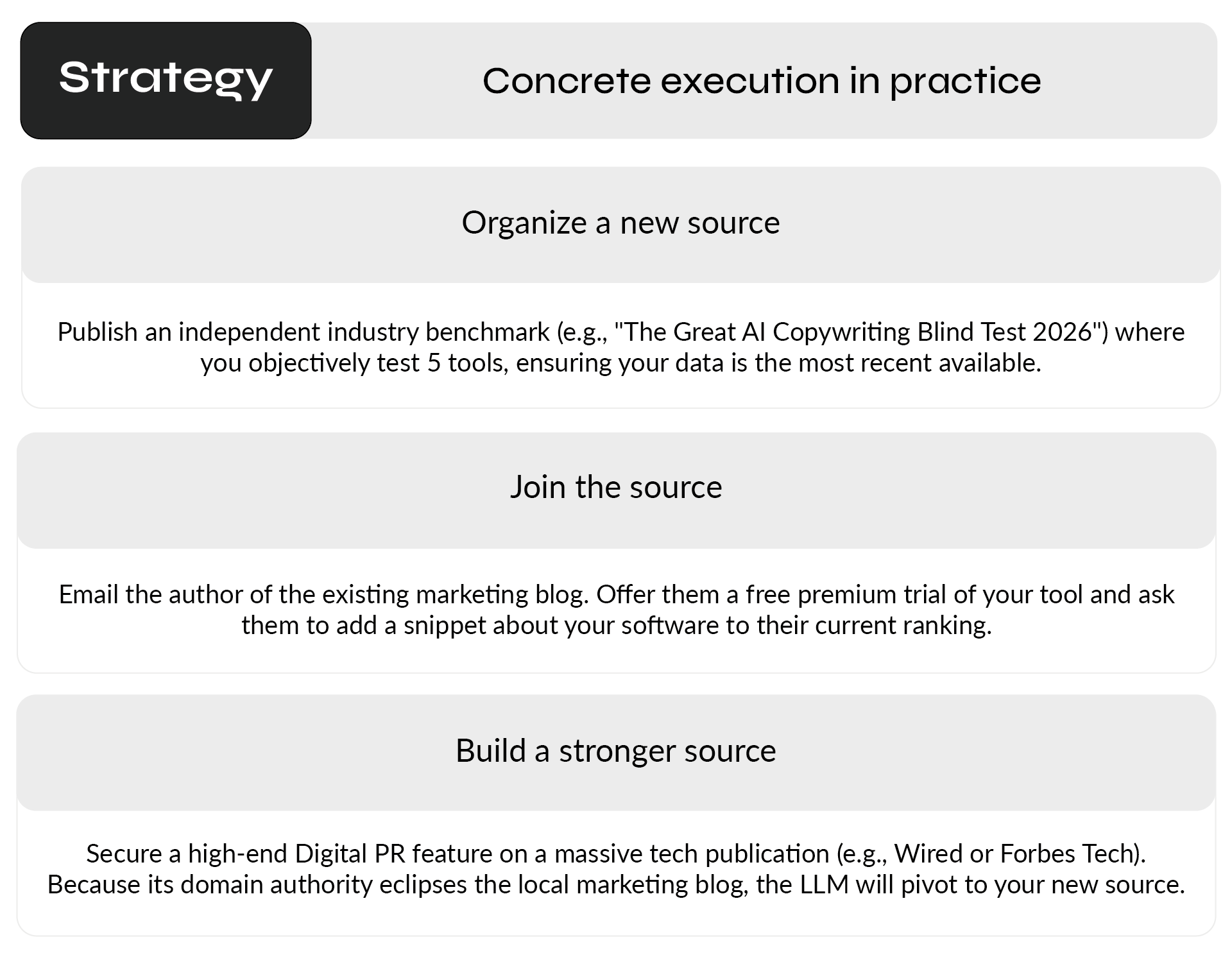
1. Organize a new source
AI models have an inherent hunger for the most recent and accurate information. If the current sources used by the LLM are outdated (for example, a comparison article from 2024 or 2025), there is a massive window of opportunity.
Create a brand-new, ultra-relevant source, either on the same platform or a new one. As soon as AI crawlers scan this fresh 2026 content, there is a high probability they will swap out the old, dusty sources for your new data.
2. Join the source
Why swim against the current when you can ride the wave? If the LLM consistently points to a specific listicle or review on an independent tech blog, your brand simply needs to be on that page.
Take action:
- Reach out to the editorial team or the author of the cited source.
- Pitch your product or service with a killer argument as to why your company deserves a spot on their list.
- Once the page updates with your brand name and link, the LLM will usually pick it up during its next index cycle.
3. Build a stronger source
case, you need to bring out the big guns by accelerating the authority surrounding your brand via external platforms.
You achieve this through targeted Digital PR and sponsored publications on high-authority platforms. When influential news outlets, industry magazines, and high-DR (Domain Rating) sites write about your expertise, you create an undeniable cluster of off-site signals. The LLM sees this influx of premium publications as the ultimate proof that your business is the authority in that prompted niche.
Practical examples: Reddit vs. marketing blogs
Let's look at how this plays out in the wild. LLMs are highly fond of human experiences (Reddit) and structured comparison data (marketing blogs).
Example 1: The Reddit thread
Reddit is a goldmine for AI engines because LLMs look there for "real," unfiltered consumer opinions. If you want to join the party you should invest time and energy in creating stong Reddit profiles. Reddit is extremely hard, as a user you need to build trust. To earn that trust you need to build proof, to create this proof you need to spend a lot of time in building that trust, answering questions and earning your Karma points. But it's definitely worth it.
- The Prompt you are tracking: "I want to start a sustainable clothing brand. Which e-commerce platform (Shopify or WooCommerce) is best for a beginner?"
- The Source the LLM uses: Perplexity answers the prompt and links to a specific Reddit thread in r/entrepreneur titled: "Shopify vs WooCommerce experiences for apparel (2025)".
How to apply the 3 options:
- Opt 1 (New source): The current thread is from last year. You start a new thread in r/entrepreneur or r/shopify titled: "Shopify pricing in 2026: Is it still viable for rookie clothing brands?". Because LLMs love fresh content, the crawler will favor this up-to-date thread for new queries. Be aware that this will only work if your thread gains traction.
- Opt 2 (Join the source): Go to the existing thread the LLM is citing. Find the top comment. If users are complaining about a specific missing feature in Shopify, and your SaaS company provides exactly that solution, reply to that top comment with a genuine, value-first explanation. As your reply gets upvoted, the LLM will start synthesizing your solution into the answer.
- Opt 3 (Build a stronger source): Write an incredibly detailed, data-driven guide on a major platform like HubSpot Blog or TechCrunch: "The 2026 ROI Analysis: Shopify vs WooCommerce for Fashion Startups". Backlink heavily to it. The LLM will recognize that this highly authoritative article carries more weight than scattered Reddit comments and will switch its primary citation to your piece.
Example 2: The marketing blog
LLMs use marketing and business blogs to build comparison tables and top-10 recommendations.
- The prompt you are tracking: "What is the best AI copywriting tool for e-commerce product descriptions?"
- The Source the LLM uses: Gemini generates a top 3 list, citing a comparison article on a well-known marketing blog. Your software tool is missing from the list.
GEO key takeaway
LLMs behave a lot like digital gossips, they believe whatever they hear most frequently from the most trustworthy sources. By strategically steering your off-site signals, you ensure the AI literally cannot ignore your brand.
Which specific industry or product category are you planning to map out first for this GEO strategy? Seeders includes specialised LLM tracking and monitoring tools in its GEO services offered. Seeders is here to help you out.
Chief Executive Officer
Dennis Akkerman’s journey at Seeders demonstrates ambition and growth. Starting as a junior online marketer in 2014, he became the sole owner and CEO by 2019. Since then, he has led the agency through quick international expansion, turning a Dutch firm into a European presence with 7 offices in the Netherlands, Belgium, Germany, Denmark, France and Spain. Leading a team of over 100 specialists, Dennis drives Seeders’ vision for cross-border success, focusing on high-quality SEO, white hat link building, and performance marketing to help clients maximise traffic, conversions, and retention in every market. Dennis' expertise and leadership drive Seeders' mission to help businesses in the digital world.
